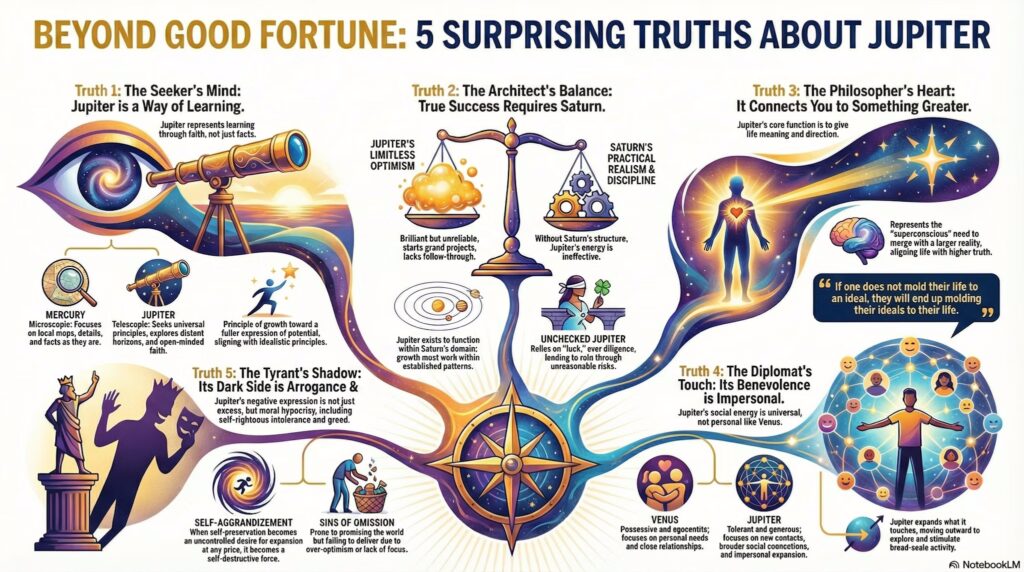
Beyond luck and expansion, Jupiter governs the shared principles that keep societies from collapsing into chaos.
Jupiter as Social Cohesion
Jupiter is the force of cohesion. In mundane astrology, we often assign the structure of society to Saturn—laws, borders, institutions, buildings. But a society is more than its infrastructure. Infrastructure does not generate trust. Government buildings do not produce legitimacy. Legal codes do not automatically produce moral agreement.
If Saturn is the bricks, Jupiter is the mortar.
Bricks can be stacked without mortar, but they will not hold under pressure. The mortar is what binds the structure into something resilient. Jupiter binds.
This is why Jupiter is intimately tied to religion, philosophy, and the sacred—because these are the domains where societies decide what is ultimately real, what is ultimately good, and what is worth sacrifice. Whatever your view of the etymology, symbolically it is perfect: religion binds. It binds people to a shared story, binds individuals to a shared moral grammar, and binds the living to an inheritance larger than themselves.
Jupiter is the social glue that allows strangers to trust one another without requiring a contract for every exchange. It is the invisible web of shared assumptions that makes etiquette, commerce, justice, and debate possible. When Jupiter is strong, the bond holds: culture coheres, and society remains resilient under pressure. When Jupiter is weak or afflicted, that bond dries out and fractures—and even the Saturnian bricks of institutions begin to pull apart.
This is one of the most important principles for interpreting modern decline: societies do not collapse first through economics; they collapse first through meaning. The economy follows.
When Jupiter Fails: The Collapse of Meaning
Jupiter’s most crucial function is its role as the arbiter of disagreement.
A society can withstand intense internal conflict if it shares a common moral substrate. People can argue fiercely over taxes, wars, healthcare, immigration, and power—but if they still agree on what is Sacred—if they agree on the dignity of the individual, the legitimacy of their constitutional order, the importance of truth, and the value of free speech—then they can disagree without destroying the container of society.
They speak the same moral language.
They’re playing the same game—even if they’re rooting for different teams.
But when Jupiterian consensus fractures, disagreement becomes something else entirely. It becomes a war between competing sacred orders—rival moral universes.
In that condition, what one side treats as Sacred, the other experiences as Profane—or worse, as oppressive. The dispute is no longer about policy; it is about reality itself. Each faction feels existentially threatened by the other’s worldview because the underlying principles are incompatible.
When shared principles collapse, language loses its binding power. Words stop having stable definitions. There is no meta-framework left to adjudicate disputes. And when there is no shared moral language to mediate conflict, the remaining options shrink to two:
- disengagement, or
- raw force.
Historically, this pattern is not rare. It is the precursor to civil breakdown: first, the collapse of shared meaning; then the collapse of trust; then the collapse of legitimacy; and only afterward, the collapse of institutions.
This is why civilizations can appear stable on paper while quietly corroding from within.
The Acceleration Trap: Technology Outpacing Character
Here the modern relevance becomes urgent.
Technological progress increases capacity—but principles determine direction.
And when moral development lags behind innovation, the result is predictable:
Better tools don’t make better people—they amplify whatever is already there.
They upgrade reach, speed, and leverage—including the leverage of deception, coercion, addiction, and manipulation.
Every advanced civilization eventually faces the same hidden test:
Can the character of the people keep pace with the power of their tools?
History offers examples. The printing press dramatically expanded access to information, but it also amplified propaganda, religious conflict, and political fragmentation. The industrial revolution increased production and lifted millions out of poverty, but it also enabled exploitation at a scale previously impossible, concentrating wealth and power into systems that eventually required new moral and legal frameworks to constrain them.
The modern digital revolution has done the same—only faster. Social media and mass connectivity can produce social cohesion, but they can also produce algorithmic outrage, mass delusion, and a breakdown of shared reality. AI systems amplify this further by accelerating persuasion, automation, and the ability to simulate truth itself.
If the culture’s principles are not robust, technology becomes a multiplier for collapse.
In other words: modernity does not primarily face an economic crisis, political crisis, or even technological crisis.
It faces a Jupiter crisis—a crisis of shared meaning, principles, and legitimacy.
The Universal Moral Algorithm
Across religions, philosophies, and even secular ethics, one deceptively simple principle appears again and again—like a civilizational operating law:
If you give more than you take, you will get more than you give.
This is profound not because it is sentimental or utopian, but because it describes relational economics—the hidden mechanics of trust and reciprocity.
This is how trust compounds.
This is how cooperation becomes profitable.
This is how a society becomes stable enough for abundance to even exist.
When this principle is widely practiced, it produces:
- trust
- social cohesion
- cooperation
- reduced transaction costs
- real community
- resilience under stress
In other words, it creates an environment where people can build without constantly defending themselves from one another.
But there is a catch.
This algorithm only works if enough people are playing the same game.
If too many people adopt the logic of extraction—take more than you give—the system collapses into predation. The takers feast on the givers, and the givers—once generous—become bitter, defensive, and eventually vengeful. Reciprocity becomes naïveté. Trust becomes surveillance. Community becomes faction.
This is why Jupiterian principles must be reinforced culturally and protected structurally. Without reinforcement, goodness is punished.
The Practical Challenge: Designing Civilization for the Givers
So the real question is not whether giving is noble.
The real question is:
How do you create systems where giving is protected and taking is constrained?
That is where Saturn comes in: laws, norms, institutions, enforcement, contracts. Jupiter and Saturn are not enemies; they are partners. Jupiter provides the moral architecture. Saturn provides the structure that defends it.
A society cannot survive on virtue alone—not because virtue is weak, but because predation exists. Civilization is, in part, the engineering solution to predation: creating environments where cooperation is sustainable.
This is why moral decline during rapid technological change is especially dangerous. The tools become more powerful faster than character does. A society can survive weak technology with strong ethics—but it rarely survives strong technology with weak ethics.
And when predation becomes more effective—when takers gain advanced tools—then giving becomes psychologically and economically unsustainable unless protected.
This is the core design challenge of civilization in the 21st century: building moral coherence at scale without collapsing into coercion.
The Jupiterian Compact: The Minimal Civilization Stack
If we were to list the shared principles that keep a society from collapsing—principles most religions affirm and secular ethics can also endorse—we could describe them as a core “Jupiterian Compact.” These are not theological doctrines. They are civilization software.
The Jupiterian Compact
- Human dignity is fundamental (people are not tools).
- Reciprocity is sacred (do unto others/fairness/karma).
- Truth matters (reality must be honored or systems collapse).
- Restraint is a hallmark of civilization (impulse control makes freedom possible).
- Responsibility is non-negotiable (you own your actions and consequences).
- Compassion is strength (the strong protect the vulnerable).
- Courage is required (do the right thing even when it costs).
- Justice must constrain wrongdoing (not vengeance, but moral boundary).
- Service is meaningful (a life worth living includes giving).
- Reverence for the whole (you belong to something larger than your ego).
This is not “religion.”
This is the minimal code required for civilization to function without devolving into predation.
And Jupiter—the planet of principles, meaning, and cohesion—rules the spread and maintenance of this code.
When the code is strong, technology becomes a multiplier for flourishing.
When the code is weak, technology becomes a multiplier for chaos.
Historical Pattern: Civilizations’ Collapse in This Order
Civilizations tend to collapse in a predictable sequence:
- Meaning collapses (shared principles fragment).
- Trust collapses (people expect exploitation).
- Legitimacy collapses (institutions are seen as corrupt or alien).
- Institutions collapse (law becomes theater; enforcement becomes factional).
- Material collapse follows (economy, safety, and infrastructure degrade).
This is why the fall of a civilization can appear sudden, even when its infrastructure remains intact. The visible collapse is merely the final stage of an invisible breakdown that began years or decades earlier.
A helpful example is the late Soviet Union: the institutional structure remained, but legitimacy collapsed. People no longer believed in the moral story of the system. Once belief evaporated, compliance became performative, and corruption became normal. Eventually, the structure could not sustain itself. Saturn remained—but Jupiter was gone.
The modern West risks a similar dynamic: not in identical form, but in the same causal order. The United Kingdom offers a vivid example of how this unfolds in real time. Even as the formal infrastructure of the state remains intact—Parliament, courts, police, regulatory agencies—the deeper Jupiterian layer of shared legitimacy has weakened. When principles fragment, trust declines; when trust declines, institutions must compensate with more rules, more enforcement, and more administrative control. But Saturn cannot substitute for Jupiter. You can strengthen surveillance, expand bureaucracy, and multiply procedures—yet without a coherent moral consensus, society becomes brittle: the system grows heavier while the social glue dries out.
Conclusion: Jupiter as the Greater Benefic
Jupiter is called the Greater Benefic not because it grants lottery winnings, but because it grants something far rarer: shared meaning.
It gives a society a philosophical rudder.
It provides the principles that enable cooperation and make conflict survivable.
It builds trust without requiring force.
It allows collective life to function without constant coercion.
When we ignore the cultivation of shared principles—focusing only on enforcing laws (Saturn) or winning immediate battles (Mars)—we erode the foundation of civilization itself.
To rebuild, we must look upstream.
Back to the deep code.
Back to the principles that determine who we are—and what we are still willing to build together.
And the deeper lesson is this:
A civilization is not defined by its technology.
It is defined by its principles.
Technology is power.
Principles are wisdom.
And without wisdom, power becomes a catastrophe.