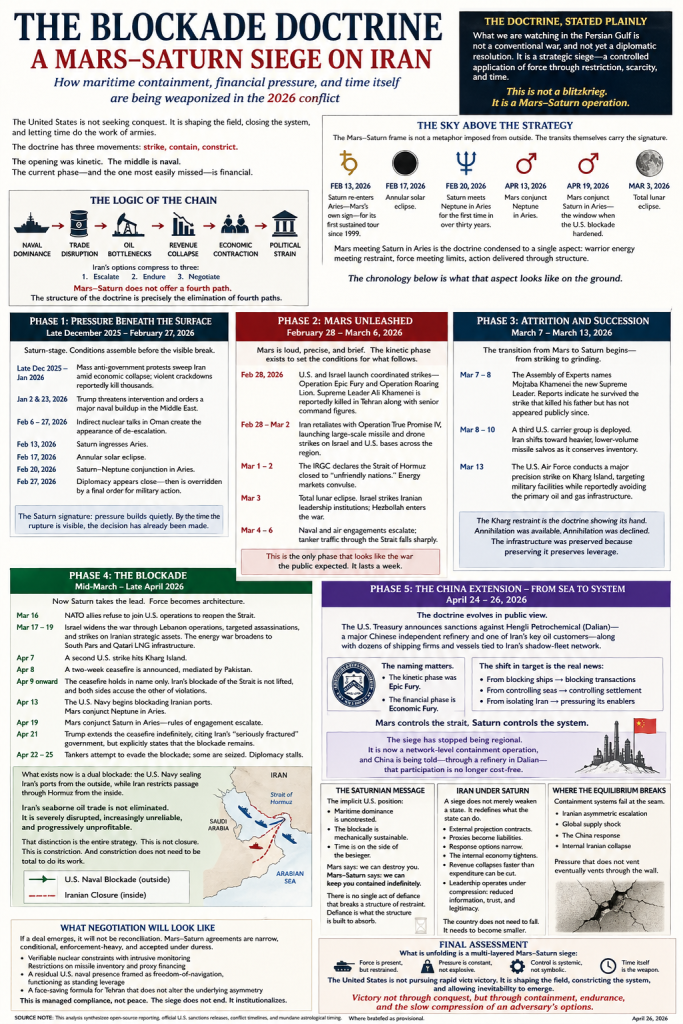
How maritime containment, financial pressure, and time itself are being weaponized in the 2026 conflict
The Doctrine, Stated Plainly
What we are watching in the Persian Gulf is not a conventional war, nor is it yet a diplomatic resolution. It is a strategic siege — a controlled application of force through restriction, scarcity, and time.
This is not a blitzkrieg. It is a Mars–Saturn operation: violence held inside structure, force converted into pressure, speed traded for inevitability. The United States is not seeking conquest. It is shaping the field, closing the system, and letting time do the work of armies.
The doctrine has three movements: strike, contain, and constrict.
The opening was kinetic.
The middle is naval.
The current phase — and the one most easily missed — is financial.
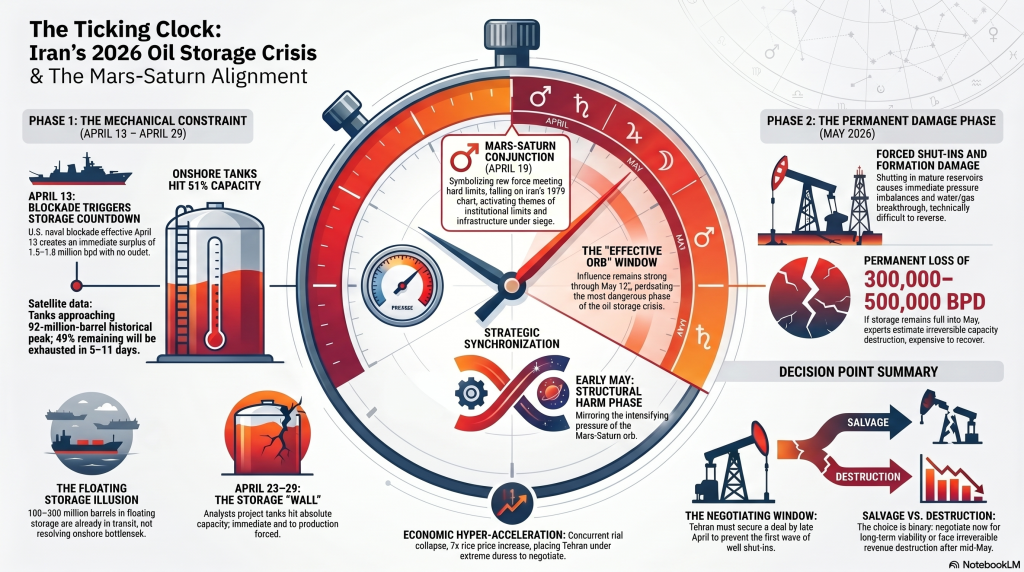
The Sky Above the Strategy
The Mars–Saturn frame is not a metaphor imposed from outside. The transits themselves carry the signature.
Saturn re-entered Aries on February 13, 2026 — Mars’s own sign — for its first sustained tour since 1999. Saturn in Aries is restraint occupying the warrior’s house: the structure of force, the rules of engagement, the discipline of containment.
One week later, on February 20, Saturn met Neptune in Aries for the first time in more than thirty years: old orders dissolving under new structural authority.
The opening strikes landed in the shadow of an annular solar eclipse on February 17 and a total lunar eclipse on March 3 — the eclipse axis bracketing the war’s first kinetic phase.
Then, in mid-April, Mars crossed the same ground:
- April 13: Mars conjunct Neptune in Aries
- April 19: Mars conjunct Saturn in Aries
This was the precise window in which the U.S. naval blockade hardened from posture into enforcement.
Mars meeting Saturn in Aries is the doctrine condensed into a single aspect: warrior energy meeting restraint, force meeting limits, action delivered through structure.
The chronology below is what that aspect looks like on the ground.
Phase 1: Pressure Beneath the Surface
Late December 2025 – February 27, 2026
Saturn-stage. Conditions assemble before the visible break.
- Late Dec 2025 – Jan 2026: Mass anti-government protests sweep Iran amid economic collapse; violent crackdowns reportedly kill thousands.
- Jan 2 & 23, 2026: Trump threatens intervention and orders a major naval buildup in the Middle East.
- Feb 6 – 27: Indirect nuclear talks in Oman create the appearance of de-escalation.
- Feb 13: Saturn ingresses Aries.
- Feb 17: Annular solar eclipse.
- Feb 20: Saturn–Neptune conjunction in Aries.
- Feb 27: Diplomacy appears close — then is overridden by a final order for military action.
The Saturn signature: pressure builds quietly. By the time the rupture is visible, the decision has already been made.
Phase 2: Mars Unleashed
February 28 – March 6, 2026
Mars is loud, precise, and brief. The kinetic phase exists to set the conditions for what follows.
- Feb 28: The U.S. and Israel launch coordinated strikes — Operation Epic Fury and Operation Roaring Lion. Supreme Leader Ali Khamenei is reportedly killed in Tehran along with senior command figures.
- Feb 28 – Mar 2: Iran retaliates with Operation True Promise IV, launching large-scale missile and drone strikes on Israel and U.S. bases across the region.
- Mar 1–2: The IRGC declares the Strait of Hormuz closed to “unfriendly nations.” Energy markets convulse.
- Mar 3: Total lunar eclipse. Israel strikes Iranian leadership institutions; Hezbollah enters the war.
- Mar 4–6: Naval and air engagements escalate; tanker traffic through the Strait falls sharply.
This is the only phase that looks like the war the public expected.
It lasts a week.
Phase 3: Attrition and Succession
March 7 – March 13, 2026
The transition from Mars to Saturn begins — from striking to grinding.
- Mar 7–8: The Assembly of Experts names Mojtaba Khamenei the new Supreme Leader. Reports indicate he survived the strike that killed his father but has not appeared publicly since.
- Mar 8–10: A third U.S. carrier group is deployed. Iran shifts toward heavier, lower-volume missile salvos to conserve its inventory.
- Mar 13: The U.S. Air Force conducts a major precision strike on Kharg Island, targeting military facilities while reportedly avoiding the primary oil and gas infrastructure.
The Kharg restraint is the doctrine showing its hand.
Annihilation was available.
Annihilation was declined.
The infrastructure was preserved because preserving it preserves leverage.
Phase 4: The Blockade
Mid-March – Late April 2026
Now Saturn takes the lead.
Force becomes architecture.
- Mar 16: NATO allies refuse to join U.S. operations to reopen the Strait.
- Mar 17–19: Israel widens the war through Lebanon operations, targeted assassinations, and strikes on Iranian strategic assets. The energy war broadens to South Pars and Qatari LNG infrastructure.
- Apr 7: A second U.S. strike hits Kharg Island.
- Apr 8: A two-week ceasefire is announced, mediated by Pakistan.
- Apr 9 onward: The ceasefire holds in name only. Iran’s blockade of the Strait is not lifted, and both sides accuse the other of violations.
- Apr 13: The U.S. Navy begins blockading Iranian ports. Mars conjoins Neptune in Aries.
- Apr 19: Mars conjoins Saturn in Aries — the literal aspect of the doctrine. Rules of engagement escalate.
- Apr 21: Trump extends the ceasefire indefinitely, citing Iran’s “seriously fractured” government, but explicitly states that the blockade remains.
- Apr 22–25: Tankers attempt to evade the blockade; some are seized. Diplomacy stalls.
What exists now is a dual blockade: the U.S. Navy sealing Iran’s ports from the outside, while Iran restricts passage through Hormuz from the inside.
Iran’s seaborne oil trade is not eliminated. It is severely disrupted, increasingly unreliable, and progressively unprofitable.
That distinction is the entire strategy.
This is not closure.
This is constriction.
And constriction does not need to be total to do its work.
Phase 5: The China Extension — From Sea to System
April 24–26, 2026
The doctrine evolves in public view.
The U.S. Treasury announces sanctions against Hengli Petrochemical (Dalian) — a major Chinese independent refinery and one of Iran’s key oil customers — alongside dozens of shipping firms and vessels tied to Iran’s shadow-fleet network.
The naming matters.
The kinetic phase was Epic Fury.
The financial phase is Economic Fury.
The continuity is intentional. The doctrine is announcing itself.
The shift in target is the real news:
- From blocking ships → blocking transactions
- From controlling seas → controlling settlement
- From isolating Iran → pressuring its enablers
Mars controls the Strait.
Saturn controls the system.
The siege has stopped being regional. It is now a network-level containment operation, and China is being told — through a refinery in Dalian — that participation is no longer cost-free.
The Logic of the Chain
The pressure now flows in a single direction:
Naval dominance → trade disruption → oil bottlenecks → revenue collapse → economic contraction → political strain → forced decision
Iran’s options compress to three:
- Escalate — and risk overwhelming retaliation against an already degraded force.
- Endure — and absorb internal collapse without external relief.
- Negotiate — under duress, on narrow terms, with enforcement built in.
Mars–Saturn does not offer a fourth path.
The structure of the doctrine is precisely the elimination of fourth paths.
The Saturnian Message
The implicit U.S. position, never spoken aloud but visible in every operational choice, is this:
- Maritime dominance is uncontested.
- The blockade is mechanically sustainable.
- Time is on the side of the besieger.
Mars says: we can destroy you.
Mars–Saturn says: we can keep you contained indefinitely.
The second is harder to answer. No single act of defiance breaks a structure of restraint. Defiance is what the structure is built to absorb.
This is what “we can do this all day” sounds like at a geopolitical scale.
Iran Under Saturn
A siege does not merely weaken a state.
It redefines what the state can do.
Under sustained Mars–Saturn pressure:
- External projection contracts.
- Proxies become liabilities, not assets.
- Response options narrow to the symbolic and the suicidal.
- The internal economy tightens.
- Revenue collapses faster than expenditure can be cut.
- Leadership operates under conditions of compression: reduced information, reduced trust, reduced legitimacy.
The country does not need to fall.
It needs to become smaller — in capability, reach, confidence, and maneuverability — than it was before the siege began.
That is the deliverable.
Where the Equilibrium Breaks
Mars–Saturn is stable until it is not.
Containment systems do not fail gradually. They fail at the seam.
The seams to watch:
- Iranian asymmetric escalation: A single high-casualty strike on a U.S. carrier or allied capital could overwhelm the doctrine’s tolerance for restraint.
- Global supply shock: Prolonged disruption of Gulf flows could impose costs on European and Asian economies that exceed their willingness to support the blockade.
- The China response: Beijing has more tools than Hengli. Sanctions on Chinese refiners invite retaliation in domains the U.S. has not yet chosen to defend.
- Internal Iranian collapse: The doctrine assumes a regime capable of negotiating its own constraint. A genuine state fracture removes the negotiating partner and replaces siege with chaos.
Each of these is a Mars-side rupture inside a Saturn-side structure.
Pressure that does not vent eventually vents through the wall.
What Negotiation Will Look Like
If a deal emerges, it will not be reconciliation.
Mars–Saturn agreements are narrow, conditional, enforcement-heavy, and accepted under duress.
Expect:
- Verifiable nuclear constraints with intrusive monitoring.
- Restrictions on missile inventory and proxy financing.
- A residual U.S. naval presence framed as freedom-of-navigation, functioning as standing leverage.
- A face-saving formula for Tehran that does not alter the underlying asymmetry.
This is managed compliance, not peace.
The siege does not end.
It institutionalizes.
Final Assessment
The dominant narrative says the blockade is “working.”
That is true and incomplete.
What is unfolding is a multi-layered Mars–Saturn siege:
- Force is present, but restrained.
- Pressure is constant, not explosive.
- Control is systemic, not symbolic.
- Time itself is the weapon.
The United States is not pursuing rapid victory. It is shaping the field, constricting the system, and allowing inevitability to emerge.
And that — at the level of geopolitics, as at the level of the natal chart — is what Mars–Saturn does:
Victory not through conquest, but through containment, endurance, and the slow compression of an adversary’s options.
The kinetic war was a week.
The siege is the policy.