On April 26, 1986, at approximately 01:23 local time, Reactor No. 4 of the Chernobyl Nuclear Power Plant exploded near Pripyat, in what was then the Ukrainian SSR, Soviet Union—now Ukraine. With dozens of direct casualties and thousands of later health complications connected to the disaster, Chernobyl remains the worst nuclear disaster in history. It is one of only two nuclear accidents rated at Level 7—the maximum severity—on the International Nuclear and Radiological Event Scale, the other being the 2011 Fukushima Daiichi accident. The emergency response and long-term mitigation effort involved more than 500,000 personnel and cost an estimated 18 billion Soviet rubles. Broader estimates place the total long-term economic cost of the disaster as high as $700 billion, making it one of the most expensive disasters in modern history.
For younger readers, Chernobyl was not only an environmental and technological disaster; it was also a defining world-historical event. The Soviet government’s initial secrecy, delayed public disclosure, and mishandling of the crisis badly damaged public trust. The disaster became inseparable from the era of glasnost and perestroika, exposing the fragility of the Soviet system and acting as a major accelerant to forces that contributed to its eventual collapse in 1991. Mikhail Gorbachev later suggested that Chernobyl may have been a deeper cause of the Soviet Union’s collapse than many political reforms themselves.
It is within this context—of invisible forces, systemic failure, and global consequence—that the event chart of Chernobyl becomes especially revealing.
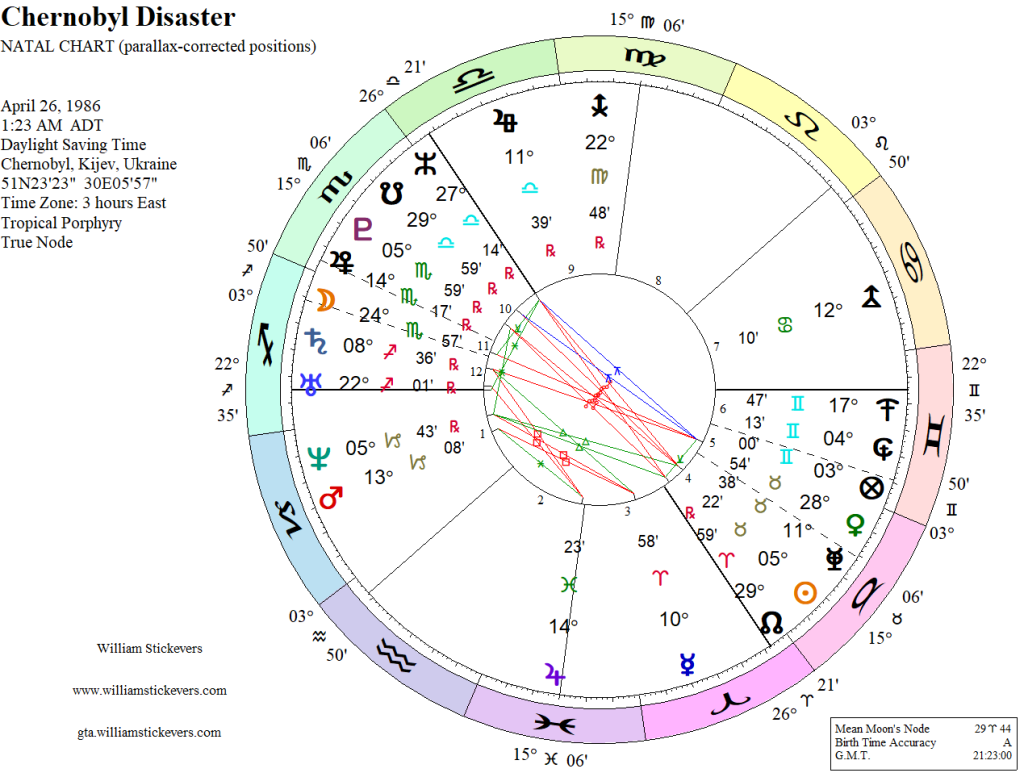
One of the most striking configurations in the event chart is the conjunction of Poseidon at 27°13′ Libra with the Midheaven at 26°21′ Libra, within less than one degree. In Uranian astrology, Poseidon and Hades are hypothetical points: Poseidon is associated with truth, illumination, radiation, invisible forces, and higher knowledge, while Hades is linked with hidden decay, illness, contamination, and what is buried or neglected.
The Midheaven signifies public visibility, collective recognition, and the way an event becomes known to the world. With Poseidon so tightly conjunct the MC, the defining signature of the chart is an invisible yet pervasive force becoming publicly manifest. In Libra, this points to a disruption of balance, equilibrium, and systemic order. Its placement in the 11th house further emphasizes collective consequences: populations, societies, networks, and the wider human community were all drawn into the event’s aftermath.
The South Node at 29°44′ Libra closely follows this conjunction, reinforcing themes of release, dissipation, and conditions that could no longer be contained. This symbolism is reflected in the spread of radioactive material beyond the reactor site, with contamination eventually detected across Europe.
Pluto at 05°59′ Scorpio, in its own sign, intensifies the chart’s symbolism of destruction, contamination, death, exposure, and irreversible transformation. Its opposition to the Sun at 05°22′ Taurus in the 5th house describes a profound confrontation between life-force, vitality, and creative continuity on one side, and plutonic forces of breakdown, toxicity, and regeneration on the other.
Pluto’s sextile to Neptune adds another layer: deep subterranean transformation working through invisible, diffuse, and hard-to-detect forces. The involvement of Hades further emphasizes hidden decay, illness, contamination, systemic failure, and the investigative uncovering of what had been buried, denied, or ignored.
Uranus at 22°00′ Sagittarius, conjunct the Ascendant at 22°35′ Sagittarius, gives the chart its sudden, shocking, and world-altering quality. Uranus on the Ascendant marks a rupture into awareness. Chernobyl forced a new understanding of technological risk, nuclear vulnerability, governmental secrecy, and global interdependence.
The eclipse sequence preceding the disaster is also significant. On April 9, 1986, a partial solar eclipse occurred. Then, on April 24, 1986—only two days before the explosion—a total lunar eclipse activated the Scorpio–Taurus axis, closely triggering the existing Pluto–Sun opposition and bringing latent tensions to a critical point of manifestation.
Taken as a whole, the chart is dominated by outer-planet symbolism: Pluto, Neptune, Uranus, Poseidon, and Hades. The eclipse activations appear to have amplified these signatures, correlating with an event that was sudden, invisible in its primary mechanism, globally consequential, and transformative in humanity’s understanding of nuclear power.
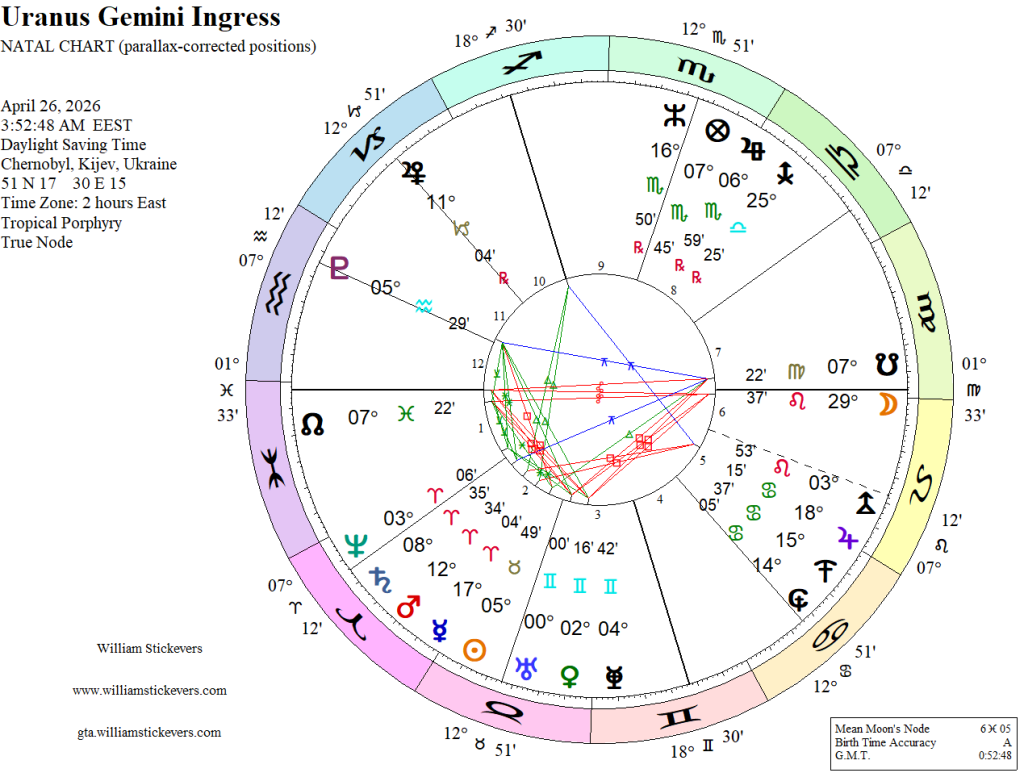
And now, as of April 25–26, 2026, Uranus has entered Gemini again for its long 2026–2033 transit. Uranus previously previewed Gemini from July 7 to November 7, 2025, then returned to Taurus before entering Gemini again in late April 2026. It remains in Gemini until August 3, 2032, briefly retrogrades back into Taurus, and then completes its Gemini transit from December 12, 2032, to May 22, 2033.
As Uranus enters Gemini again for its long 2026–2033 transit, the Chernobyl chart becomes more than historical symbolism—it becomes a warning. In 1986, the invisible force was radiation. In the coming Uranus-in-Gemini cycle, the invisible force is information itself: AI, algorithms, cyber systems, surveillance networks, propaganda engines, and weaponized narratives. Chernobyl exposed the deadly cost of technological arrogance and institutional secrecy; Uranus in Gemini may expose the equally destabilizing cost of informational arrogance—systems moving faster than human wisdom, governance, or moral accountability can contain. The next “meltdown” may not be nuclear. It may be cognitive, digital, financial, or civilizational: a rupture in the very networks through which humanity thinks, trades, governs, and understands reality