1. From Psychological Structures to Ontological Principles
Classical Jungian psychology situates archetypes within the collective unconscious as inherited, a priori structures that organize psychic experience. While Jung repeatedly emphasized their psychoid nature, suggesting a bridge between psyche and matter, he stopped short of fully identifying archetypes with the fundamental structure of reality itself. In Jung’s formulation, archetypes are disclosed empirically through dreams, myths, and symbolic processes, and function primarily as form-giving principles within the psyche.
Yet this positioning leaves unresolved a deeper metaphysical question: are archetypes merely structures of human cognition, or do they reflect something intrinsic to reality as such?
The present framework advances a more decisive ontological claim: archetypes are not contained within the psyche; rather, both psyche and cosmos arise as expressions within an underlying archetypal field. This move reclassifies archetypes from epistemological structures, or modes of apprehension, to ontological primitives, or conditions of being.
2. Archetypes as Differentiative Tendencies of Being
At the most fundamental level, reality may be conceived as undifferentiated potential, prior to spacetime, determinate form, and discrete entities. For such potential to manifest as a structured world, differentiation must occur. That differentiation cannot be arbitrary. It must proceed according to intrinsic tendencies that determine why reality actualizes in one patterned way rather than another.
These intrinsic tendencies are what we designate as archetypes.
Archetypes, therefore, are not entities, forces, or symbolic representations. They are irreducible differentiative tendencies inherent to existence itself, through which indeterminate potential becomes structured, meaningful reality.
They function analogously to attractors in dynamical systems, but with one crucial distinction: they are not emergent from underlying processes, but constitutive of the conditions under which any process can arise. In this sense, archetypes are prior to both physical law and mental representation.
To exist is to exhibit determinate properties rather than others that might have been exhibited. Archetypes are precisely these property-defining constraints: the qualitative vectors along which existence unfolds.
3. Reframing the Mind-Matter Dualism
By elevating archetypes to the level of ontological primitives, the traditional dualism between mind and matter is substantially reframed. Rather than treating psyche and cosmos as fundamentally distinct domains, both may be understood as co-expressions of the same archetypal differentiation.
The psyche appears as the interior, experiential dimension of archetypal structuring. The cosmos appears as its exterior, observable dimension.
On this view, the apparent division between inner and outer, subject and object, becomes a perspectival distinction within a more unified field. Archetypes are neither “in” the mind nor imposed upon a mind-independent material world. They constitute the common generative grammar through which both mind and world arise.
This position aligns with certain strands of idealism and process philosophy while preserving the empirical insights of depth psychology. It also reframes the so-called hard problem of meaning: meaning is no longer treated as a late-emergent or merely projected feature, but as intrinsic to differentiation itself. Every pattern carries significance insofar as it is a determinate expression of an archetypal tendency.
4. Implications for Astrology: Acausal Correspondence
One of the most significant applications of this framework concerns astrology. Modern critiques of astrology typically rest on the absence of a plausible causal mechanism by which distant celestial bodies could influence human affairs. Even contemporary psychological astrology often retains a residual crypto-mechanistic vocabulary, speaking of planetary “energies” or “influences.”
Within an archetypal ontology, the demand for a causal mechanism is fundamentally reframed.
Planets do not cause events through physical forces. Rather, planetary configurations and human experiences are simultaneous expressions of the same underlying archetypal configuration. Astrology, therefore, operates not through efficient causation but through acausal correspondence, akin to, though extending beyond, Jung’s notion of synchronicity.
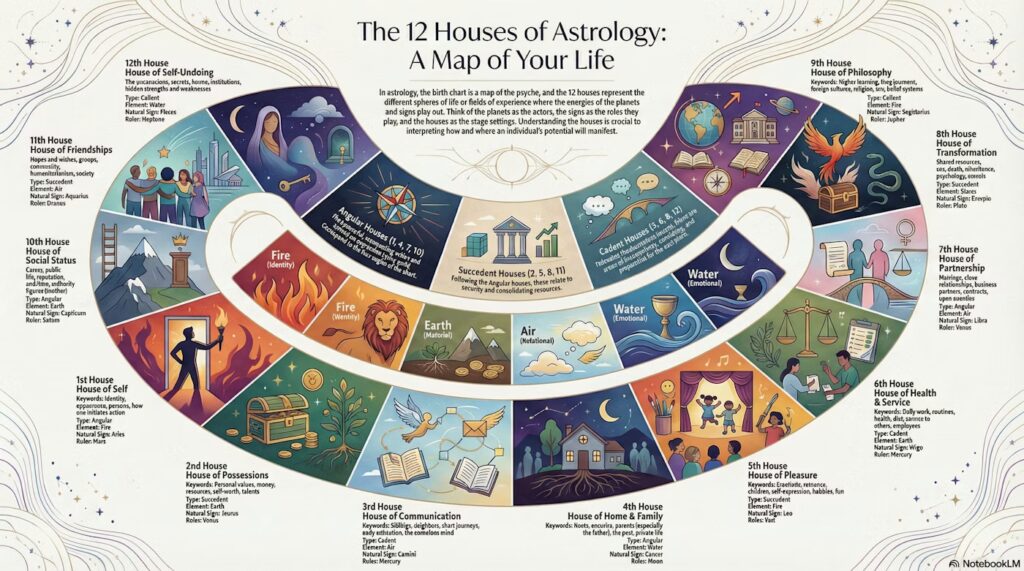
A natal chart may thus be understood as a symbolic crystallization of the archetypal configuration operative at the moment of an individual’s emergence into differentiated existence.
This restores the classical principle as above, so below as an ontological statement rather than a metaphor. The heavens and human life are linked not by causal chains, but by shared participation in the same differentiative field.
5. Archetypes, Meaning, and the Structure of Reality
Reconceiving archetypes as ontological primitives carries broader implications across multiple domains.
Cosmology: The emergence of spacetime and physical law may be understood as expressions of deeper archetypal ratios or structures.
Biology: Development and evolution may be reframed as processes of archetypal instantiation, in which form emerges along prefigured qualitative tendencies.
Physics: The so-called unreasonable effectiveness of mathematics suggests that quantitative laws may reflect deeper archetypal harmonics.
Epistemology: Knowledge becomes participatory, an alignment with archetypal structure, rather than a merely representational relation to an external, inert reality.
In this view, reality is not a meaningless substrate upon which significance is later imposed. Differentiation itself is meaningful because it is archetypal. Every level of existence, physical, biological, psychological, and cultural, manifests the same underlying grammar of becoming. Archetypes are the means by which Being articulates itself into multiplicity while retaining coherence.
6. Conclusion
The elevation of archetypes from psychological constructs to ontological primitives offers a unified framework for integrating mind, matter, and meaning within a single explanatory schema. It addresses longstanding tensions between scientific materialism and symbolic or experiential domains, not by rejecting empirical rigor, but by enlarging the ontological basis upon which such rigor rests.
Within this framework, archetypes are neither abstractions nor metaphors. They are the intrinsic differentiative tendencies through which reality becomes what it is rather than what it could have been. Psyche and cosmos alike are expressions of this deeper order.
Such a perspective does not merely reinterpret Jung or rehabilitate astrology. It points toward a post-reductionist ontology in which meaning is not anomalous, but intrinsic to the very structure of existence.
Key Takeaways
- Archetypes are being reframed from psychological contents into ontological primitives: not things in the mind, but basic conditions of being.
- On this view, archetypes are irreducible differentiative tendencies through which undetermined potential becomes structured, meaningful reality.
- This means archetypes are not entities, forces, or symbols; they are the qualitative constraints that make reality actualize one way rather than another.
- The framework reframes mind and matter as co-expressions of the same underlying archetypal field, rather than as separate substances.
- Meaning is treated as intrinsic to differentiation itself, not as something merely projected by human minds onto an otherwise inert universe.
- Astrology becomes defensible in a non-mechanistic way: planets do not cause events, but planetary configurations and human experience can be seen as simultaneous expressions of the same archetypal pattern.
- A natal chart is therefore framed as a symbolic crystallization of the archetypal configuration present at the moment of emergence into differentiated existence.
- The model has implications beyond astrology, extending into cosmology, biology, physics, and epistemology, where recurring structure may reflect deeper archetypal order.
- The overall aim is a post-reductionist ontology that integrates mind, matter, and meaning without reducing one to the others.