Prologue: The Barber’s Fifth Brother
Most of us live inside a quiet ache. There is the life we are leading and the life we are imagining, and between them runs a chasm that widens the longer we stare into it. Dr. Marc Edmund Jones — philosopher, clergyman, screenwriter, and astrologer remembered as the “Dean of American Astrology” — called this condition “near-tragic frustration.” He opened his most enduring book, The Sabian Symbols in Astrology, with a parable he believed captured it perfectly.
In an old tale from the Arabian Nights, the barber’s fifth brother inherits a hundred silver coins. He invests the whole sum in glassware and lays it out in the marketplace, expecting a modest profit by day’s end. But as he waits for buyers, he begins to “pyramid his gains” in a daydream that quickly outruns him. The glass becomes a fortune; the fortune becomes a palace; the palace earns him such standing that he imagines demanding the Prime Minister’s daughter in marriage. By the height of the reverie, he has grown so haughty that when his imagined bride presses her affections on him, he kicks out his foot to repel her — and shatters his actual stock of glass on the ground.
Jones did not retell this story for its comedy. He retold it because, in his diagnosis, it renders the spiritual disease of the modern person in miniature. The brother is not destroyed by imagination. He is destroyed by his failure to handle a symbol. He confuses the dream with the reality it was meant to seed, becomes “nonparticipant and miserable” in his own life, and crushes the very materials from which a real future could have been built. “Symbols,” Jones insisted, are not decorative or incidental. They are “the magic and the symptoms” by which we construct the fiber of existence. Misuse them, and the glassware breaks. Wield them well, and the world reshapes itself around you.
This is the doctrine that animates everything Jones wrote — and the reason his quiet revolution still matters, nearly a century after he and a clairvoyant in San Diego sat down for an afternoon and altered the course of Western astrology.
Part I — The Reform: From Fate to Agency
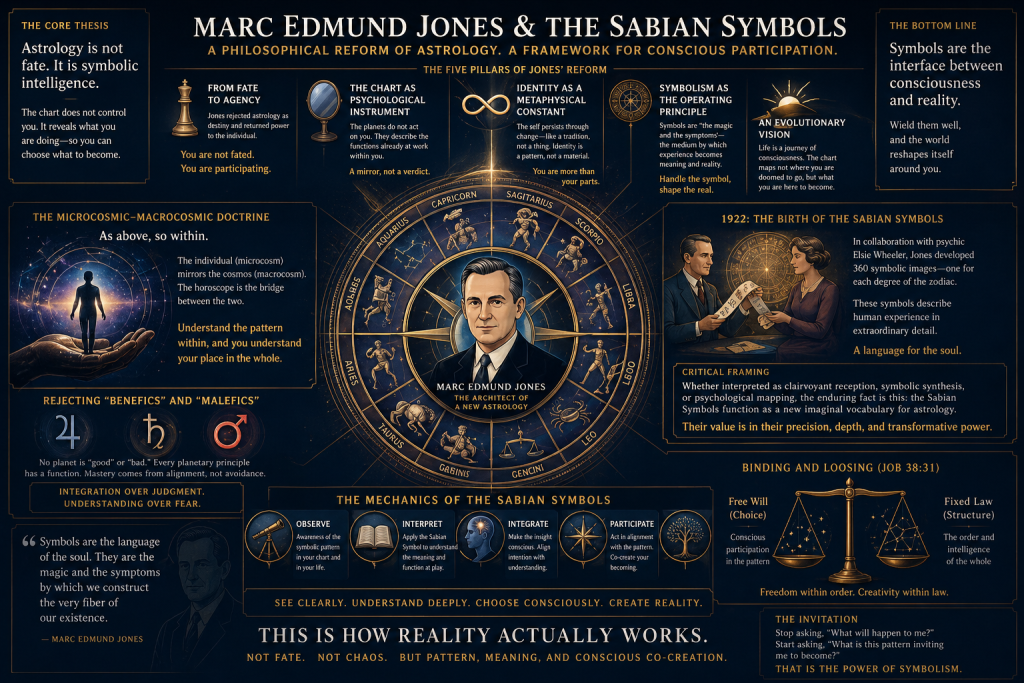
Before Jones, Western astrology in the popular imagination was largely fatalistic. Planets were forces. Houses were destinies. Aspects were verdicts. The chart was a sentence handed down at birth, and the practitioner’s job was to read it aloud. Jones’s central act was to refuse this framing.
He moved away from what he called “the age-old notion that the power is in the stars” and rejected the zodiac as “a mystic conglomeration of heavenly influences” before which the human being must submissively bow. More radically still, he abandoned the inherited language of “benefics” and “malefics” — Jupiter the kindly, Saturn the cruel, Mars the bringer of war — refusing to treat any portion of human experience as inherently good or evil fate. To do so, he argued, was to mistake the map for the territory and disempower the very person the chart was meant to serve.
In place of fate, Jones offered a different metaphor: the chart as psychological organon — a sophisticated instrument for character analysis. The planets do not act on you. They give you a precise vocabulary for functions already at work within you. The Sun is not your destiny; it is the symbol by which you recognize and consciously administer the creative principle inside yourself. Saturn is not a sentence to hardship; it is the symbol that allows you to see and work with the structuring principle by which life acquires durable form.
In this frame, the chart is a mirror, not a verdict. It does not tell you what will happen. It helps you see, with unusual precision, what you are already doing — so you can decide whether to keep doing it.
This shift, more than any single technical innovation, is Jones’s lasting contribution. It moved astrology, for the modern Western reader, from a cosmology of compulsion into a psychology of choice. And it created the philosophical clearing in which his student-rivals Dane Rudhyar, Marc Robertson, and the humanistic and evolutionary schools that followed could grow.
Part II — Identity as a Metaphysical Constant
Once power is returned to the person, an obvious question arises: who, exactly, is this person? Jones’s answer is the philosophical heart of the work, and more radical than it first appears.
We tend to treat identity as a fixed biological fact — a thing made of cells and history, sitting somewhere behind the eyes. Jones invites us to see it instead as a “metaphysical constant”: real, durable, recognizable across time, yet never reducible to any of its parts.
He reaches for two homely illustrations. The first is the “one-hoss shay” of Oliver Wendell Holmes’s poem — a carriage so perfectly built that it lasts a hundred years and then collapses all at once into dust. The second is the Model-T Ford. Replace, over fifteen years, every component of the car — chassis, wood, upholstery, every nut and bolt — and at the end of that process, is it still the same Ford? In ordinary speech, we say yes, even though, atom for atom, nothing of the original remains.
The example he loved most was institutional. Marshall Field’s, the great Chicago department store he watched across the decades, was unmistakably “the same” Marshall Field’s in his lifetime as it had been in 1865 — though every building had been rebuilt, every employee replaced, every piece of stock turned over countless times. What persisted did not matter. What persisted was, in Jones’s words, a “tradition” or a “morale” — an identity in the Platonic sense, an “entity which can be a universal and a particular one at the same time.”
The same logic, he insists, applies to us. The body remakes its flesh through eating and cellular replacement; the mind conducts a “continual stream of meanings” through consciousness. We are not a collection of parts. We are a coherence — a pattern that gathers material to itself, holds it for a while, and lets it go. This pattern begins early. The child mimicking a parent is not engaged in idle exuberance; the child is performing a “rehearsal for the self,” trying on a draft of personhood and seeing whether it fits.
From this comes Jones’s most quietly liberating sentence:
“Reality after all must be seen in its true nature as a glorified make-believe.”
If identity is, as he puts it, a “continuous reconstruction of experience,” then the script is not handed to you. You are writing it, line by line, by the symbols you accept and the ones you refuse. The barber’s fifth brother is not condemned because he imagines a palace. He is condemned because he becomes so identified with one symbol — the haughty husband — that he loses the ability to handle the actual glass at his feet. Identity, handled well, is a creative act. Handled badly, it is glassware on the pavement.
Part III — You Are the Universe in Miniature
If identity is a coherence rather than a thing, the next question is: a coherence of what, and patterned after what? Jones’s answer is the ancient microcosmic-macrocosmic doctrine — the conviction that the human being is “a complete if miniature replica of the total” universe.
This is not a sentimental claim. It is the structural reason, in Jones’s view, that astrology can work at all. The patterns we observe in the heavens are not foreign forces reaching down to push us around. They are, in his phrase, “Godlike stabilities in man” — generalized versions of the same organizing principles that constitute us. When we look at the “celestial organism,” we obtain “a confirmation of ourselves.”
This is why the zodiac maps so readily onto the human body — Aries at the head, Taurus the neck and throat, Gemini the lungs and arms, down to Pisces at the feet. The correspondence is not due to the stars ruling the body. It is because the stars and the body are two expressions of one underlying invisible order, and either can be used to read the other.
The implication is profound and, for the modern reader, disorienting. We do not look at the sky to find something other than ourselves. We look at the sky to find a generalized portrait of the vast intelligence we already are. The wise person, Jones writes, “lives the world in himself” — recognizes that personal history is a localized expression of cosmic order, and that cosmic order can in turn be addressed through one’s own life. Inner work and outer cosmology are not two projects. They are one.
Part IV — The Sabian Synthesis: Tapping an Ancient Wisdom
The single innovation for which Jones is best remembered did not come from a library. It came from an afternoon in San Diego in 1925.
Jones had spent years searching for a way to give the 360 degrees of the zodiac the granular, image-rich vocabulary he believed they had once possessed in the lost astronomical priesthoods of Mesopotamia. He found his collaborator in Elsie Wheeler, a clairvoyant of remarkable focus who, despite advanced rheumatoid arthritis, was able to enter a receptive state and report, one degree at a time, the specific image she “saw” for each of the 360 positions of the wheel.
The pace was extraordinary — close to one symbol per minute over two sessions. Jones believed that what was occurring was not invention but recovery: a “psychological rapport” with what he called the ancient Sabian Brotherhood, the keepers of the original Babylonian-Mesopotamian symbolic tradition who first perfected the art of celestial interpretation. The 360 images, in his view, were not Wheeler’s inventions or his own. They were a “re-creation of the basic matrix” used by the ancient masters, surfacing through a willing channel.
Here, some critical framing is necessary. The historical status of Jones’s Sabian Brotherhood and the precise nature of Wheeler’s clairvoyant process remain matters of interpretation rather than demonstrable historical fact. Whether one accepts Jones’s account as literal recovery, inspired clairvoyance, or symbolic authorship, the enduring fact is that the Sabian Symbols functioned as a new imaginal vocabulary for astrology. Their value may be approached devotionally, psychologically, poetically, or practically — but their effect on twentieth-century astrology is undeniable.
The internal coherence of the resulting symbol set — the way themes rhyme across signs, the way each sequence of degrees develops a recognizable arc — convinced Jones that the work was not random. It was structured. And the name he gave to the school he founded around it, the Sabian Assembly, established in 1923, tells us how seriously he took the lineage.
The symbols themselves became, in his hands, “catalytics to the astrologer’s higher understanding” — not horoscope decorations, but instruments that allow a practitioner to read a chart with the specificity of a fingerprint rather than the vagueness of a sun-sign column.
Part V — Mental Metabolism: The Therapy of Binding and Loosening
If the Sabian Symbols are Jones’s technical tool, his philosophical tool is a passage from the Book of Job. From the whirlwind, the Divine asks Job a question Jones returns to again and again:
“Canst thou bind the sweet influences of Pleiades, or loose the bands of Orion?”
Jones reads this couplet as a complete spiritual physiology. The Pleiades represent the elective side of life — the things we can choose, cultivate, gather toward us, “bind” to ourselves by an act of will. Orion represents the fixed side — the structural givens of existence, the things we cannot move and must instead learn to “loose” ourselves from.
Job’s “sorry state,” Jones argues, was not the misfortune itself. It was an “unnecessary incompatibility with the world” — an obsessive over-identification with what could not be changed, which paralyzed his ability to act on what could. Job had stopped metabolizing. He was holding everything and digesting nothing.
From this Jones derives one of his most useful images: the mind as administrator of the body, charged with running a “mental metabolism.” Just as the body lives by assimilation and elimination — taking in food, air, water, and releasing what it has finished with — the healthy psyche lives by taking in symbols and letting them go.
When we become “obsessed with a situation,” our mental digestion has stalled. We are trying to live on stored meaning, the way a person trying to live on yesterday’s air would suffocate. The therapy is not to think more about the obsession. It is to loose it — to release the symbol that has overstayed, so fresh meaning can move through. This is the inner work that makes the outer work — chart, rectification, daily transit — actually do something.
Part VI — Symptoms Are Symbolic Language
What happens when the metabolism does not work? In Jones’s view, the body and the life take over the job. The unmetabolized symbol does not disappear; it migrates. It becomes a symptom.
He cites dramatic cases — the stigmata of St. Francis, where intense devotion to the wounds of Christ surfaces as wounds in the saint’s own body — and ordinary ones, like the schoolchild who wakes on the morning of a feared examination with a real headache. In Jones’s view, “life’s ever-present symbols become quite personal symptoms.” The body is not lying. It is speaking the symbolic language the conscious mind refused to hear.
But the same machinery that produces symptoms can be reversed and used for what Jones calls mental catalysis — what older traditions would have called magic, in the original sense. Here he reaches for Nathaniel Hawthorne’s tale of the Great Stone Face: a boy in a New England valley grows up gazing at the noble face carved by erosion into a mountain. He holds it as an inner image of greatness, year after year, and slowly his own features and bearing begin to take on the shape of the stone. By the end of his life, he is the prophesied figure he had been waiting for.
This is, for Jones, the positive form of the same law that destroys the barber’s fifth brother. We use the “fetish power” of symbols — keepsakes, mementos, vows, images held in the mind’s eye — to “pyramid” significance and create what he calls a “transcendental experience.” A simple object, surcharged with meaning, can transform a person’s orientation regardless of outer circumstance. Romance and art rely on this principle constantly. So does every spiritual practice worthy of the name.
The difference between symptom and catalysis is not in the symbol. It is in whether you are administering it or being administered by it.
Part VII — Applications: The Astrological Arts as Verification
Jones was not content to leave any of this at the level of philosophy. He insisted that the doctrine be testable, and he applied it across every major branch of astrological practice.
Rectification — the work of reconstructing an unknown or uncertain birth time — became, for him, a precise application of the metaphysical-constant doctrine. If identity is a coherent pattern, then the lived facts of a biography should match, with surprising specificity, the symbols of the suspected Ascendant and Part of Fortune. He used the Sabian Symbols as a biographical fingerprinting tool, checking remembered turning points against degree imagery to verify the minute a person was actually born.
Transits and daily guidance received the same treatment. Jones tracked the daily motion of the planets across natal degrees and read them through the symbol set, treating each morning not as a continuation of yesterday but as a “rebirth” — a fresh “regrasping of destiny’s threads.” The point was not prediction in the parlor-game sense. The point was orientation: what is today for?
Horary astrology — the ancient practice of casting a chart for the moment a question is sincerely asked — became, in Jones’s hands, an exercise in matching degree symbols to “the fluid realities of the situation.” The chart was no longer a static description of cosmic forces. It was a living image of the asker’s actual condition, framed in symbolic language they could use.
In each case, the test was the same: does the symbolic reading clarify the person’s situation in a way they can act on? Jones drew on a working library of one thousand horoscopes of public figures to refine and demonstrate the method, building, in effect, a research laboratory for the inner life. He acknowledged the limits: with only a thousand charts, no system can illustrate every degree, especially when slow-moving discoveries like Neptune and Pluto have yet to complete a full circuit of the zodiac. The honesty about limits was part of the rigor.
Part VIII — From Actor to Agent
Jones’s work invites a person to step out of the role of “victim of the stars” and into the role of “creative actor.” That step alone, made consciously, is the work of a lifetime. But he points beyond it to a further evolution he calls planetary consciousness.
At this stage, the actor becomes an agent. You no longer experience life as a personal performance against a cosmic backdrop. You experience it as a localized concentration of a larger movement — the universe’s purpose finding itself, momentarily and precisely, through you. The ego is no longer the protagonist. It becomes, in his phrase, a “crystalline lens” through which a higher will is focused into individualized acts.
This is not self-erasure. It is the opposite. The agent does more, not less, than the actor. But the source of the doing has shifted. The actor is performing a role; the agent is allowing a purpose. The actor is making things happen; the agent is becoming the place where things can happen well. The barber’s fifth brother, on this reading, was not even an actor yet — he was a sleepwalker. Much of human spiritual development is the slow business of waking up far enough to act consciously, then relaxing far enough to let the larger pattern act through us.
Conclusion: The Glassware in Front of You
There is a useful exercise hidden inside everything Jones wrote. Look at the symbols you are currently carrying — the identity you are rehearsing, the future you are pyramiding in your mind, the situations you are obsessing over, the keepsakes you have surcharged with meaning. Then look at the actual glassware in front of you. The actual relationship. The actual work. The actual body. The actual day.
Are the symbols you are administering helping you handle what is in front of you with more skill, presence, and love? Or are they causing you to kick out your foot and shatter what is real?
If identity is a role you are currently rehearsing — and Jones is convinced that it is — then the only question worth asking is the one his life’s work was designed to provoke:
Are you playing a part that leads to your fulfillment, or are you just kicking over your own glassware?
About the Author: Dr. Marc Edmund Jones (1888–1980)
Dr. Marc Edmund Jones, widely regarded as the Dean of American Astrology, was a polymath whose influence quietly reshaped twentieth-century Western esotericism. A high-school dropout who later earned a Ph.D. in philosophy from Columbia University, his life became a working demonstration of his theory of identity as continuous self-reconstruction.
Before becoming a foundational figure in modern astrology, Jones was a pioneer in the early American film industry, writing scenarios for silent films and playing an instrumental role in organizing efforts that grew into the Screen Writers Guild. He was also an ordained Presbyterian clergyman, serving for five years as a parish minister — an experience that marked the moral seriousness of his later esoteric work.
In 1923 he founded the Sabian Assembly, a study group dedicated to philosophy, comparative religion, and what he understood as the recovery of an ancient Mesopotamian — “Sabian” — wisdom tradition. Two years later, in San Diego in 1925, he and the clairvoyant Elsie Wheeler produced the now-famous Sabian Symbols: a vivid image assigned to each of the 360 degrees of the zodiac, giving Western astrologers a new depth of psychological and predictive specificity.
Across a long and prolific career, Jones produced foundational texts including The Sabian Symbols in Astrology, The Essentials of Astrological Analysis, How to Learn Astrology, Astrology: How and Why It Works, Occult Philosophy, and philosophical works on Plato and the Bhagavad Gita. He developed the now-standard system of chart shaping patterns — Splash, Bowl, Bucket, Locomotive, See-Saw, Splay, Bundle — still used by practitioners around the world. His reform of the craft, away from fatalism and toward psychological agency, opened the conceptual space in which Dane Rudhyar’s Humanistic Astrology and the evolutionary school that followed could flourish.
Dr. Jones remained active as a teacher and writer until his death in 1980, leaving behind a body of work that continues to invite each new reader to the same quiet, demanding question: not what the stars will do to you, but what you, knowing the stars, will choose to do.