Most calendar years contain four eclipses—two solar, two lunar—neatly arranged around the lunar nodes. But the geometry of the Saros cycle occasionally produces years that overspill this rhythm, packing six or even seven eclipses into a single twelve-month span. These crowded years are not astronomically rare in the long view, but they are infrequent enough that each one feels like a punctuation mark in the celestial calendar.
Mundane astrology—the branch concerned with collective and political life rather than personal horoscopes—has long treated such years as periods of heightened activation. The claim is not causal. Eclipses do not pull governments down or push markets off cliffs. But the observational record across the past century suggests that eclipse-dense years correlate, with surprising regularity, with moments of rupture, transition, and systemic stress. The following chronology surveys every six- and seven-eclipse year from 1908 through 2047, pairing each with its historical signature.
A Note on Method
What counts as eclipse-dense? This survey defines an eclipse-dense year as any calendar year containing six or more eclipses of any kind. The ordinary annual count is four (two solar, two lunar); six or seven is the practical maximum and occurs only when the timing of eclipse seasons allows an extra pair to fall inside the same year. Years with five eclipses exist but are excluded here to keep the category sharp.
Source. Eclipse counts and types are drawn from NASA’s Five Millennium Canon of Solar Eclipses and the corresponding canon of lunar eclipses (Espenak and Meeus), cross-checked against timeanddate.com. Where this article’s earlier drafts relied on a secondary outline, the figures have been verified against the primary catalog—the December 1908 event, for instance, is correctly a hybrid rather than a total eclipse.
Counting convention. Eclipses are tallied by calendar year in Universal Time (UTC), using the date of greatest eclipse. This matters at year boundaries: an eclipse near local midnight on December 31 or January 1 may fall in a different year depending on the time zone, so a strictly local-date count could occasionally disagree with the totals here. All counts in this article use the UTC date.
Weighting. For transparency and reproducibility, the headline counts in this survey treat every eclipse equally: a grazing penumbral lunar eclipse is tallied the same as a central total solar eclipse. This keeps the category objective and checkable against the catalog. But a flat count is the starting point of a mundane reading, not its substance. Traditional practice weights an eclipse by its magnitude, by whether its path of visibility crosses the affected nation, and above all by its angularity and aspect to the relevant mundane chart—a total eclipse falling on a national Ascendant or Midheaven, or within orb of a sensitive degree, carries weight a distant penumbral cannot. Read this way, some years gain force the raw tally hides: 1935’s five solar eclipses, or the December total that closed 2020, count for more than their numerical share. The flat counts below indicate which years merit closer examination; the real signal lies there.
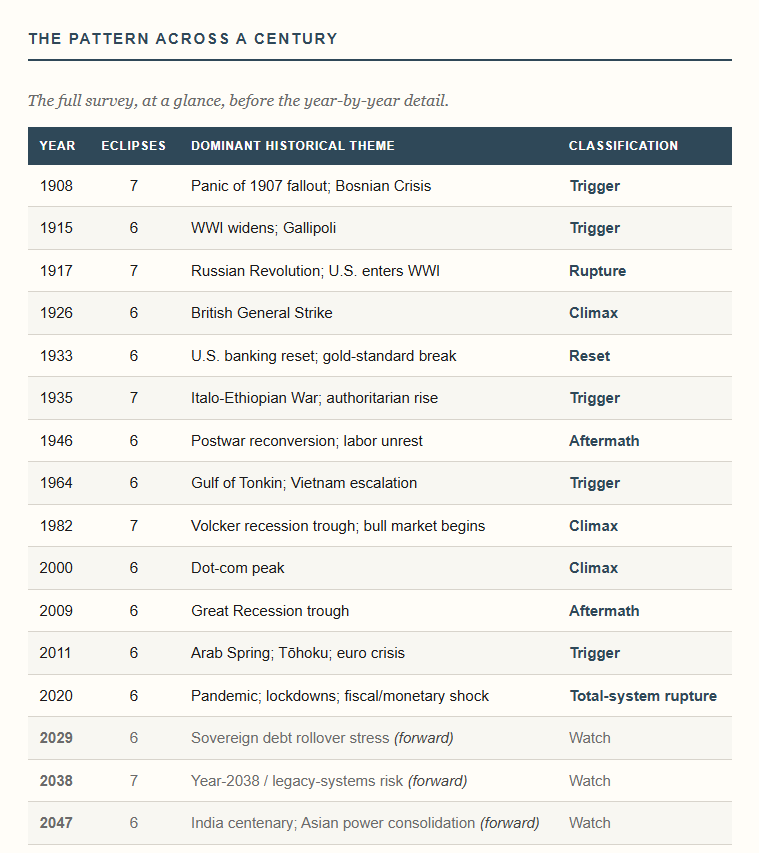
The thirteen completed years are surveyed below; the three forward-watch years follow in their own section.
1908 — Seven eclipses, prewar tension
The year opened with a total solar eclipse on January 3 and closed with a rare hybrid eclipse on December 23, bracketing the lunar penumbras and a midyear annular between them. Historically, 1908 sits in the long shadow of the Panic of 1907, often described as the first truly global financial crisis. The Bosnian Crisis intensified Balkan friction within Europe’s hardening alliance system, setting trajectories that would culminate six years later. As a trigger year, 1908 illustrates how geopolitical tension and monetary fragility can compound beneath an otherwise stable surface.
1915 — Six eclipses, war expansion
With two solar and four lunar eclipses, 1915 marked the year that the First World War lost any remaining illusion of brevity. The Gallipoli Campaign—a strategic gamble against the Ottoman Empire—failed at enormous human cost, while fronts hardened across Europe. A trigger of military overreach and imperial drain.
1917 — Seven eclipses, revolution and intervention
Four solar eclipses in a single year is unusual. The historical correspondence is striking. The February and October Revolutions ended three centuries of Romanov rule and installed Bolshevik power in Russia, while the United States entered the war in April. A few years in the modern era contain a more decisive geopolitical realignment. This was a rupture year in the fullest sense.
Between the wars and after: 1926, 1946, 1964
Three of the eclipse-dense years that followed share a common shape—major institutional stress without full systemic rupture. 1926 brought the British General Strike, with miners, transport workers, and heavy industry in direct confrontation with the state (climax—industrial conflict at a defining peak). 1946 delivered the postwar reconversion shock: a record wave of U.S. labor stoppages, surging inflation, and the early crystallization of the Cold War order (aftermath—the turbulence that follows total war rather than the war itself). 1964 combined the Gulf of Tonkin incident and the sharp expansion of U.S. involvement in Vietnam with robust economic growth at home, the doubled quality of expansion on the surface and escalation beneath (trigger). None of these years matched 1917 or 2020 in magnitude, but each sits at a recognizable inflection point.
1933 — Six eclipses, financial-system reset
If 2020 is the cleanest modern correspondence, 1933 is the cleanest historical one—a single, datable, deliberate act of state that maps almost exactly onto an eclipse-dense year. By the winter of 1932–33, the American banking system was in terminal cascade: depositors had pulled funds en masse, state after state had declared local banking moratoria, and the machinery of credit had effectively seized. On March 6, 1933, two days into his presidency, Franklin Roosevelt declared a nationwide bank holiday, suspending all banking operations to halt the runs and buy time for triage.
What makes 1933 the chronology’s tidiest case is the structure of the intervention. The holiday was not a collapse but a controlled shutdown—a system deliberately switched off to be repaired. The Emergency Banking Act, passed within days, sorted solvent institutions from insolvent ones; when banks reopened, deposits began flowing back. The same year saw the United States leave the gold standard and the creation of federal deposit insurance, which would not see another systemic bank run for decades. The eclipse-dense year thus brackets not a rupture but the precise pivot from rupture to repair—a rupture-to-reset threshold in the most literal sense the typology allows.
1935 — Seven eclipses, authoritarian escalation
Five solar eclipses in a single year is exceptional. The historical signature was the onset of the Italo-Ethiopian War alongside the broader interwar acceleration of authoritarian consolidation and military revisionism. The atmosphere of the prewar years intensified visibly. Trigger year—external aggression escalating toward the catastrophe to come.
1982 — Seven eclipses, capitulation, and reversal
1982 belongs to the chronology’s market-cycle cases, and it is among the cleanest of those. The 1981–82 recession was the deepest U.S. downturn since the Great Depression: unemployment climbed past ten percent as the Federal Reserve under Paul Volcker held interest rates punishingly high to break the inflation of the previous decade. The economy and the markets absorbed sustained pain through the first half of the year.
Then the turn came. In August 1982, with inflation finally broken and the Fed beginning to ease, the equity market bottomed and reversed—the start of the long secular bull market that would run, with interruptions, for the rest of the century. The pattern is the signature of a climax year in the technical sense: not the onset of a crisis but its exhaustion, the capitulation that precedes the reversal. Where 1933 marks a deliberate reset by policy, 1982 marks the more organic kind—a cycle wringing itself out and then beginning again.
2000 — Six eclipses, speculative climax
The dot-com peak fell within the eclipse-dense year of 2000, with the bust unfolding across the two years that followed. Climax year—terminal valuation excess and trend break.
2009 — Six eclipses, crisis management, and bottoming
The terminal phase of the Great Recession brought extraordinary policy intervention, stabilization measures, and a generational market low in March. Aftermath year—stabilization following systemic rupture, the mirror image of 2000.
2011 — Six eclipses, multi-front instability
The Arab Spring uprisings, the Tōhoku earthquake and Fukushima disaster, and the euro-area sovereign debt crisis combined to produce a year of synchronized geopolitical and macroeconomic stress on three continents. Trigger year of multi-front activation.
2020 — Six eclipses, total-system shock
If any year in the chronology functions as a test case for the entire thesis, it is 2020. The eclipses themselves were not visually dramatic—four lunar penumbras, an annular solar in June, and a total solar in December—but their distribution across the year traced an unusual arc, with three eclipses falling within the same June–July window and another pair in the final weeks.
What followed those eclipses needs little summary. The COVID-19 pandemic produced the first synchronous global lockdown in modern history. Within weeks, the structural assumptions of late-globalization economies were under simultaneous stress: public health systems exceeded capacity; central banks improvised emergency facilities that dwarfed anything attempted in 2009; supply chains seized and then reorganized; labor markets bifurcated between remote-capable and exposed workers; equity markets crashed and then staged the fastest recovery on record. The Great Lockdown was followed by the largest peacetime fiscal expansion in history, the seeds of the 2021–22 inflation, and a durable reorganization of how a substantial fraction of white-collar work is performed.
The classification—rupture year, total-system disruption—is the strongest the typology offers, and 2020 earns it on every axis the framework tracks. A note on what the framing does and does not claim is worth making here, where the stakes are clearest. Mundane astrology has never claimed to supply efficient causes; the pandemic had a proximate biological origin and a long epidemiological backstory, and no eclipse table would have named the pathogen. What the tradition claims is timing—that the configurations mark when the fabric is most liable to tear, not what tears it. On that narrower and older claim, 2020 reads less as coincidence than as a textbook instance: a crowded eclipse year culminating in a December total, opening onto the most synchronized global rupture in living memory.
☉ ☽ ☉
The Forward Watch
Three eclipse-dense years remain ahead within this chronology.
2029 — Six eclipses
Global public debt is on a trajectory to exceed 100 percent of world GDP. 2029 emerges as a candidate watch year for sovereign debt rollover stress, refinancing pressure, and tests of policy credibility.
2038 — Seven eclipses
The Year 2038 problem—the rollover of 32-bit Unix time on January 19 of that year—raises the prospect of embedded-systems vulnerabilities in legacy digital infrastructure. A watch year for infrastructure fragility and cyber-operational risk.
2047 — Six eclipses
The centenary of Indian independence falls in 2047, framed within the national horizon of Viksit Bharat @2047. The year may mark a symbolic threshold in the consolidation of Asian developmental-state ambition and broader shifts in global power distribution. A watch year for strategic milestones and emerging-power assertion.
Reading the Pattern Honestly
A chronology of this kind invites an obvious objection, and it deserves a straight answer rather than a defensive one. The objection is selection: the twentieth century holds only about a dozen eclipse-dense years but several thousand events of arguable significance, so pairing the two will yield correspondences whether or not they mean anything. A skeptic could assemble a similar chronicle around years containing a Friday the 13th in October and produce a comparable list of panics and pivots. And the four-eclipse years left out here—the great majority of the century—include ruptures of their own: 1929, 1939, 1945, 1968, 1989, 2001, 2008, some larger than anything in the eclipse-dense set. The objection is real and must be met head-on; what it cannot do is settle the matter by itself, because it tests the wrong thing.
A frequentist would press the point with a control, and the exercise is worth running on its own terms. Fix a neutral definition of a “major stress year”—recession, the onset or escalation of a major war, a systemic financial crisis—and apply it blind to both groups. Most of the thirteen eclipse-dense years qualify; but so does a strikingly similar share of ordinary four-eclipse years, because the twentieth century was simply dense with stress, recessions alone recurring on a four-to-seven-year cadence. By that crude tally, eclipse density buys little. The mundane tradition’s answer is not to dispute the arithmetic but to reject the test: eclipses have never been held to operate by count. They operate by condition—by whether the path of totality crosses the nation in question, by the eclipse’s angularity to the founding chart, by contact with a sensitive degree carried forward from an earlier ingress or eclipse. A year with seven faint penumbral lunars invisible over the affected territory should, on this reasoning, do little; a single total eclipse cutting across a capital and falling on its national Midheaven should do a great deal. A flat hit-or-miss control measures the wrong variable, and so it understates rather than refutes the pattern. The honest qualification is the converse one: this survey has not done the conditional work either—it has not cast the mundane charts, traced the visibility paths, or tested the angularities that would turn correspondence into a defensible reading. It establishes which years are worth that labor; it does not substitute for it.
What the chronology offers, then, is a map of where to look—the years in which the sky is crowded enough to repay a full mundane analysis—rather than a finished verdict. The geometry does not generate the inflection. But it marks the years in which, by the tradition’s own logic, an inflection is most worth watching for.
Closing Note
So where does this leave the thesis? Two things can be held at once. The eclipse-dense years are not a mechanical forecasting device, and anyone who insists that 2029 or 2038 must bring crisis because the tally is high has mistaken the count for the reading—the count only flags the years that merit the work. But the chronology is far more than pattern-seeking, and the reason is specific: the strongest cases here—1917, 1933, 2020—are not loose mood-matches but tight, datable correspondences in which a singular historical pivot lands squarely inside a crowded eclipse year. Coincidence produces a loose pattern easily; it produces a tight one less easily, and three of them less easily still. To a reader versed in mundane work, that is not noise. It is precisely the signature one expects when the conditional factors—angularity, visibility, contact with sensitive degrees—happen to align with the raw density.
A measure of humility remains warranted; the conditional analysis that would convert these correspondences into firm readings has yet to be done here, and until it is, judgment carries part of the load. But the forward years are worth marking on the calendar in earnest—not as prophecy, but as the dates on which to cast the charts, trace the paths, and watch with particular attention: debt rollovers in 2029, legacy infrastructure in 2038, the strategic ambitions of a rising Asia in 2047. The chronicle carries its own dates for testing, which is more than most claims about the future offer, and more than enough reason to keep it close. The sky has crowded before. It will crowd again. The work is to be ready when it does.